Igor Rumi Motion, 3D & graphic design
Case study · Personal project · 2026

Lost Online · 404

Q: Where does generative video help a 3D pipeline, and where does it get in the way?

A 3D spider writes 404 in yarn. I built it in Blender, then put LTX-2.3 to work on it.

Final film. Spider, threads and number fully in Blender, composited in After Effects.

01 · The world

Between a lab diagram and a toy

A pale grey-blue floor, neon threads with a few dark-brown accents, and a spider that feels alive: quick, tiny steps and a highlight in the eyes.

The threads behave like real yarn, soft and heavy, curling into loops instead of sharp lines.
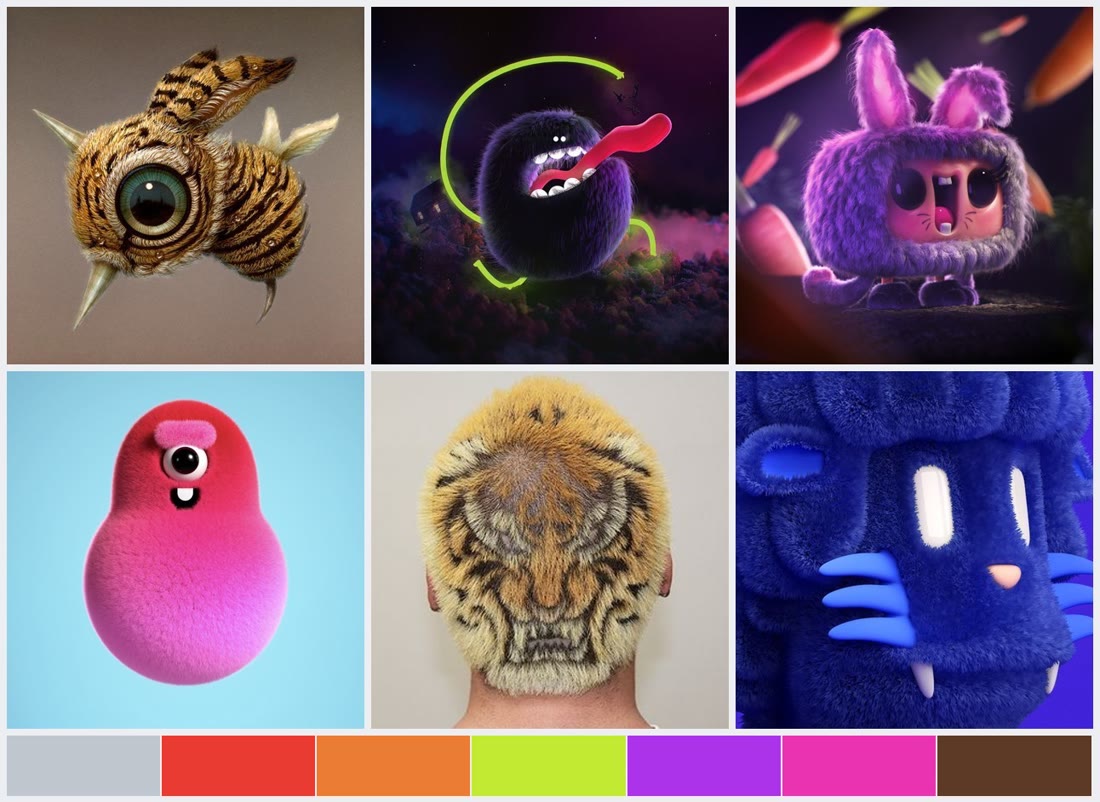
Reference board of furry 3D characters and tiger-striped fur, with the film's colour palette
References (other artists' work, collected for mood) and the palette taken from the final threads.

02 · Building it

Two cameras, one floor, a lot of yarn

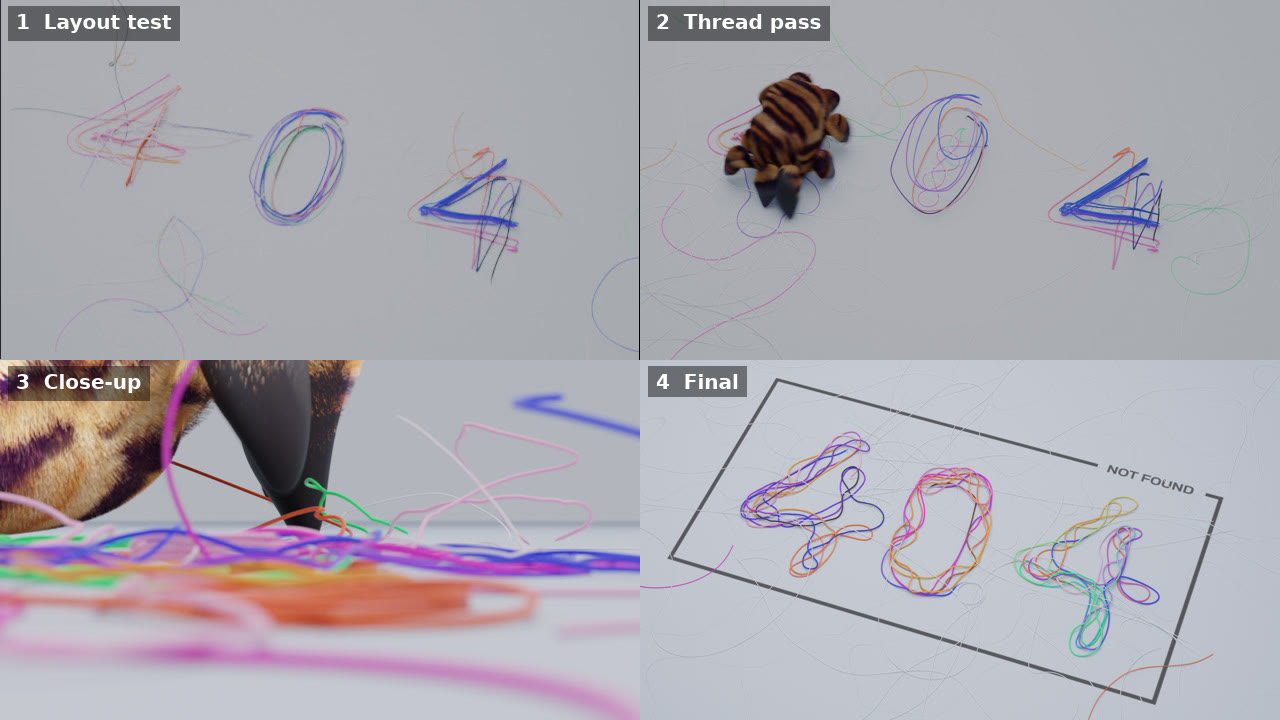
The spider, the threads and both cameras live in Blender: a top view and a 3/4 isometric view. Threads shoot from the side legs, fall and stack on each other, and fill the digits with noise-driven loops.

The floor renders as a separate pass, so I can add graphics under the threads in After Effects.

Four stages: early top-view test, iteration with the spider, foot close-up, final frame
From early top-view tests to the final frame.

03 · Testing LTX-2.3

Same spider, two modes

I ran LTX-2.3 locally in ComfyUI through a pipeline I built around it. A small Blender add-on exports keyframes, a depth pass and a quick EEVEE base for each shot, and ComfyUI turns them into video.

EEVEE preview with patchy fur, depth pass, and clean LTX output
Input → output in video-to-video mode. A fast 704×384 EEVEE preview becomes a 1408×768 shot.
Left: depth only. Right: video-to-video on my Blender animation.
Depth only

The model gets a first frame and a depth pass and has to invent the motion. The spider walked mechanically and its legs hovered above the floor. At 352×192 the legs blur in the depth and foot contact is invisible, so the model can't tell how a spider walks.

Video-to-video on my animation

The model gets my animation as a fast EEVEE render plus depth, with a finished Cycles frame as the first keyframe, and redraws it at 0.725. Every step and foot contact stayed mine, frame by frame. The noise disappeared and the fur came out clean. At 0.9 it starts changing the poses.

Legs and floor up close, half speed. Top: depth only. Bottom: video-to-video.

04 · Where it breaks

Then I pushed it further

I ran the same pipeline on harder shots to find the edges.

  • Fast motionA runner leaping across speakers failed even with a shaded 3D figure, correct depth and a lower redraw: legs vanished mid-clip and a third leg appeared. Medium-speed motion held.
  • Hero objects driftThe speakers turned into boomboxes and their texture hallucinated.
  • Thin choreography gets lostThe yarn threads came back plausible but redrawn: edge correlation with my base dropped to 0.31, against 0.70 on the walk.

My rule now: AI for characters with volume and texture at slow or medium speed. Blender for fast shots, text, fine graphics and hero objects. That's why the threads and the number in 404 stay fully in Blender: they are exactly the thin choreography the model redraws.

05 · Notes for the model

What I'd tell the team

Observations from the tests, written as feedback.